Quiet Nerves Review: Does It Actually Work, and Who Is It For?
Does Quiet Nerves actually work?
Quiet Nerves is nutritional support, not a cure, so it will not treat neuropathy. What it does is deliver six research-familiar nerve actives in one daily capsule. Whether it helps depends on the amounts and your own situation, and the 60-day guarantee lets you test it against the label on the bottle before committing.
- Leads with alpha lipoic acid and L-carnitine, two of the best-studied nerve actives.
- Realistic timeline is weeks for comfort, months for any structural support.
- Buy from the official store to keep the guarantee and multi-bottle pricing.
If you have landed on this Quiet Nerves review before hitting the buy button, you are asking the right question: does it actually work, and is it worth the money? That is a smarter place to start than most product pages want you to be, because nerve-support supplements are one of the most heavily marketed corners of the entire supplement aisle. Our job here is not to cheerlead. It is to open the hood, test Quiet Nerves against the ingredients that genuinely have human research behind them, be honest about what the label does and does not tell you, and help you decide whether this particular bottle fits your situation before you spend a cent.
Here is the frame we will use throughout. A nerve supplement is only as good as three things: the ingredients it chose, the amount of each one, and whether the price and guarantee let you try it without gambling. We will walk Quiet Nerves through all three, name the one caveat every buyer should know about up front, and set realistic expectations for how long a fair trial actually takes. No disease claims, no miracle language — just the same checklist we would use on any product on the shelf.
What is Quiet Nerves, exactly?
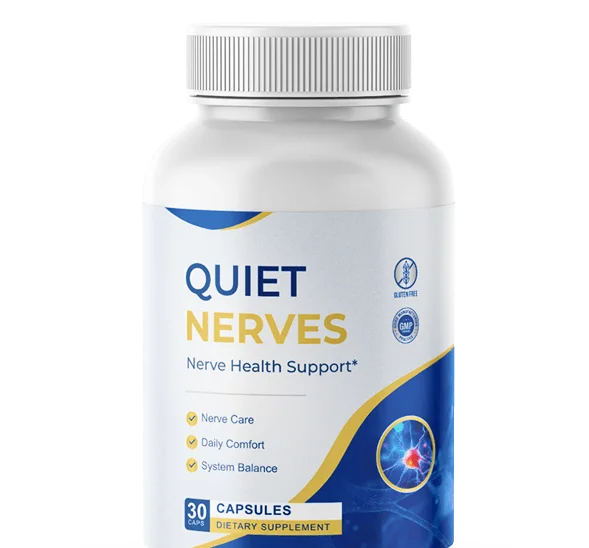
Quiet Nerves is a once-daily nerve-health dietary supplement sold at 30 capsules per bottle — one capsule a day, taken with a meal. It is positioned as an all-in-one nerve-support stack, the kind you take instead of juggling four or five separate bottles. The formula combines six ingredients: magnesium glycinate, alpha lipoic acid, L-carnitine, turmeric extract standardized to 95% curcuminoids, butcher's broom and coenzyme Q10. That is a deliberately antioxidant- and cellular-energy-focused lineup, and as we will see, it maps closely onto the actives that dominate the published nerve-support literature.
It is sold through an official online store rather than in pharmacies, with the usual direct-to-consumer structure: a higher price on a single bottle, meaningful discounts on multi-bottle packs, and a 60-day money-back guarantee that covers the purchase. Understanding that structure matters for the "does it work and is it worth it" question, because the guarantee is effectively the manufacturer letting you run your own trial at low financial risk.
Quiet Nerves review of the four evidence-backed nerve actives
The honest way to review any nerve formula is to compare it against the ingredients that have actually been tested in people. In this category, four names come up again and again: alpha lipoic acid, methylcobalamin, benfotiamine and acetyl-L-carnitine. Let us take each one, and be transparent about which ones Quiet Nerves includes and which it does not.
Alpha lipoic acid — the anchor ingredient, and Quiet Nerves has it

If any one nutrient anchors this whole category, it is alpha lipoic acid (ALA). The most-cited oral studies used around 600 mg a day as a standalone ingredient, and that figure is the benchmark every serious buyer should keep in mind. ALA is unusual in being both fat- and water-soluble, which is part of why it has been studied so heavily for nerve comfort. Quiet Nerves puts ALA near the top of its ingredient list, which is exactly where you want to see it. If you want the full picture on how much research actually used, our deep dive on the alpha lipoic acid dosage studied for neuropathy lays out the numbers.
Acetyl-L-carnitine — the regeneration outlier
Acetyl-L-carnitine (ALCAR) is the rare active in this space studied specifically for nerve-fiber support rather than comfort alone, which is a meaningfully different claim. Here the form matters enormously: plain L-carnitine and L-carnitine tartrate are not interchangeable with acetyl-L-carnitine. Quiet Nerves lists "L-carnitine" on its label, which is a point worth clarifying against the panel on arrival — if you specifically want the ALCAR research to apply, you want the label to say acetyl-L-carnitine. This is the kind of detail a genuine review flags rather than glosses over.
Benfotiamine and methylcobalamin — the pairing Quiet Nerves leaves out
Benfotiamine (a fat-soluble form of vitamin B1) and methylcobalamin (the active form of B12) are the classic B-vitamin pairing you will see in many nerve formulas, valued because B12 is directly involved in maintaining the myelin sheath that insulates nerves. In the interest of an honest Quiet Nerves review, this is where the formula diverges from the "textbook" nerve stack: Quiet Nerves does not list benfotiamine or methylcobalamin. It bets instead on antioxidant and cellular-energy actives (ALA, turmeric, CoQ10, L-carnitine) plus magnesium and butcher's broom for circulation support. Neither approach is wrong, but if a B-vitamin base is your priority, you will want to weigh that. Our Acetyl-L-Carnitine for Nerve Health and Neuropathy: The Regeneration Evidence, Explained Honestly shows how different formulas make this trade.
Want to read the Supplement Facts panel yourself?
The 60-day money-back guarantee lets you order Quiet Nerves, check the milligram amounts printed on the bottle you receive, and return it if the formula does not suit you. See current pricing and the full guarantee in one place.
Check Today's Price & GuaranteeDosing transparency: the one caveat every buyer should know
Now the caveat we promised, because a review that skips it is not worth reading. The Quiet Nerves sales page names its six ingredients but does not publish a full Supplement Facts panel with the milligram amount of each active before you buy. That is extremely common in direct-to-consumer supplements, and it is not evidence of a bad product — but it does mean you cannot pre-verify, for example, whether the ALA is at or near the ~600 mg studied benchmark, or whether the L-carnitine is the acetylated form.
This is the single most important sentence in any nerve-supplement review: a formula only inherits an ingredient's research if it matches that ingredient's studied dose and form. Because Quiet Nerves does not show its amounts up front, the honest move is to treat the 60-day guarantee as your verification tool. Order, read the panel printed on the bottle, compare it against the benchmarks above, and if the amounts do not suit you, use the return window. That is a legitimate, low-risk way to answer a question the sales copy leaves open.
Does Quiet Nerves work? Setting realistic timelines
"Does it work" is really two questions hiding in one, because there are two different clocks. The first is comfort: how your nerves feel day to day. When ingredients like ALA and turmeric help, that kind of change is usually reported over a few weeks of consistent daily use. The second clock is structural: the nerve-fiber support that actives like L-carnitine have been studied for. That is measured in months — typically three to six — because nerves adapt slowly and supplements build effect gradually.
What this means practically: judging Quiet Nerves after a week is judging it before it has had a chance to do anything. A fair trial is measured in months, taken every single day, ideally paired with the basics that support nerve health in the first place — steady blood sugar, movement, and going easy on alcohol. This is also why the 60-day guarantee is genuinely useful rather than a gimmick: it is long enough to see whether the comfort clock moves for you, while removing the financial downside if it does not.
Who Quiet Nerves suits — and who should skip it

Quiet Nerves is a good fit if you want a convenient, single-capsule nerve-support stack and would rather not manage four separate bottles of ALA, carnitine, turmeric and magnesium; if you value the antioxidant-and-energy approach; and if a 60-day money-back window is enough reassurance to try something new. It is also a reasonable fit for people who want to layer nutritional support on top of, not instead of, whatever their healthcare provider already recommends.
It is not the right pick if your priority is a B-vitamin-led formula built around benfotiamine and methylcobalamin — Quiet Nerves does not include those. It is also not for anyone hoping a supplement will replace medical care or reverse nerve damage; no dietary supplement does that, and any product claiming otherwise is making a claim it is not allowed to make. And if you take prescription medication or manage a condition such as diabetes or a thyroid disorder, the right first step is a conversation with your doctor or pharmacist, because ingredients like ALA can interact with blood-sugar management.
Three objections we hear about Quiet Nerves
"There are no independent clinical trials on Quiet Nerves itself." True — and true of nearly every consumer nerve blend. The research exists at the ingredient level, not the branded-product level. That is exactly why we review the actives and their studied doses rather than trusting a brand name, and why the missing panel matters so much.
"It's more expensive than buying plain alpha lipoic acid." Also true. A standalone ALA product is cheaper per month. What you pay extra for with Quiet Nerves is the convenience of one capsule and five additional support actives you would otherwise buy separately. Whether that convenience is worth it is a personal call — just compare the cost per daily serving, not the sticker price, and remember the multi-bottle pack lowers it substantially.
"The testimonials look too good." Manufacturer testimonials are marketing, not evidence, and they describe individual experiences that are not typical. Read them as social proof at most, and anchor your decision on the ingredient list, the guarantee, and your own trial. For broader context, our roundup of how to judge neuropathy supplement reviews explains which signals to trust and which to ignore.
Cost, guarantee and where to buy Quiet Nerves
Pricing follows the standard multi-bottle model. A single bottle carries the highest per-unit cost; the popular six-bottle pack drops the price to around $49 a bottle, which is where most buyers land because the cost per daily serving is lowest there. Every order is backed by a 60-day money-back guarantee, and, as covered above, that guarantee doubles as your way to verify the label after purchase.
On where to buy: the official store is the right place, full stop. That is where the guarantee applies, where pricing is verified, and where the multi-bottle discounts live. Third-party marketplaces can mean higher prices, no guarantee, or stock the manufacturer cannot vouch for. If you have read this far and the antioxidant-led, one-capsule approach fits what you want, the sensible next step is to check current official pricing and the guarantee terms directly.
Related reading
Frequently asked questions
Does Quiet Nerves really work for nerve health?
Quiet Nerves is a nutritional support supplement, not a drug, so it does not treat, cure or prevent neuropathy. Whether it helps you depends on the ingredients and their amounts. The formula leads with actives that have real human research behind them for nerve comfort and function — alpha lipoic acid, L-carnitine, turmeric extract, magnesium glycinate, butcher's broom and CoQ10 — so it is a sensibly composed stack. The honest expectation is support for healthy nerve function alongside medical care, not a fix.
What ingredients are in Quiet Nerves?
Quiet Nerves is a once-daily formula with six ingredients: magnesium glycinate, alpha lipoic acid, L-carnitine, turmeric extract standardized to 95% curcuminoids, butcher's broom and coenzyme Q10. It leans on the antioxidant and cellular-energy actives that dominate the nerve-support research. Notably, it does not list benfotiamine or methylcobalamin, two ingredients some competing nerve formulas include, so it is worth checking the panel against your own priorities.
How long before Quiet Nerves shows results?
Timelines vary by person and by what you are tracking. Comfort-related changes, when they occur, are often reported over a few weeks of consistent daily use, while any structural or nerve-fiber support studied for these ingredients is measured over months, typically three to six. Supplements work gradually and depend on consistency, so a fair trial is measured in months, not days. The 60-day money-back guarantee is designed to cover a genuine trial period.
Where is the best place to buy Quiet Nerves?
The best place to buy Quiet Nerves is the official store, because that is where the 60-day money-back guarantee, verified pricing and multi-bottle discounts apply. Single bottles cost more per unit; the six-bottle pack drops the price to around $49 a bottle. Buying through third-party marketplaces risks paying more, missing the guarantee, or receiving stock the manufacturer cannot verify.
References
- Ziegler D et al. Oral treatment with alpha-lipoic acid (the SYDNEY 2 trial). Diabetes Care, 2006 — source of the 600 mg/day oral figure
- Sima AAF et al. Acetyl-L-carnitine and nerve fiber regeneration in diabetic neuropathy. Diabetes Care, 2005
- NIH Office of Dietary Supplements — Vitamin B12: Fact Sheet for Health Professionals
- U.S. FDA — Dietary Supplement Labeling Guide (Supplement Facts and proprietary blend rules)
- U.S. FTC — Health Products Compliance Guidance (claims and testimonials)
Ready to try the formula this review covers?
See current official-store pricing, the six-bottle cost per serving, and the full 60-day money-back terms — then read the panel on arrival and decide for yourself.
Order Quiet Nerves From The Official Store